What's the Synopsis of a Letter to My Mother That She Will Never Read Ocean Vogue
| Langston Hughes | |
|---|---|
 1936 photo past Carl Van Vechten | |
| Born | James Mercer Langston Hughes (1901-02-01)February ane, 1901 Joplin, Missouri, U.Due south. |
| Died | May 22, 1967(1967-05-22) (aged 66) New York City, New York, U.S. |
| Occupation |
|
| Education | Columbia Academy Lincoln University |
| Period | 1926–1964 |
| Relatives | John Mercer Langston |
James Mercer Langston Hughes (February 1, 1901[i] – May 22, 1967) was an American poet, social activist, novelist, playwright, and columnist from Joplin, Missouri. Ane of the primeval innovators of the literary art form chosen jazz poetry, Hughes is all-time known as a leader of the Harlem Renaissance. He famously wrote about the flow that "the Negro was in faddy", which was later paraphrased as "when Harlem was in vogue."[ii]
Growing upwardly in a series of Midwestern towns, Hughes became a prolific writer at an early age. He moved to New York City every bit a young human, where he made his career. He graduated from high school in Cleveland, Ohio, and soon began studies at Columbia University in New York Urban center. Although he dropped out, he gained notice from New York publishers, first in The Crisis magazine, so from book publishers and became known in the artistic community in Harlem. He eventually graduated from Lincoln Academy. In improver to poesy, Hughes wrote plays, and short stories. He also published several non-fiction works. From 1942 to 1962, every bit the civil rights move was gaining traction, he wrote an in-depth weekly column in a leading black newspaper, The Chicago Defender.
Biography
Beginnings and childhood
Like many African-Americans, Hughes had a complex ancestry. Both of Hughes' paternal not bad-grandmothers were enslaved Africans, and both of his paternal peachy-grandfathers were white slave owners in Kentucky. According to Hughes, 1 of these men was Sam Clay, a Scottish-American whiskey distiller of Henry County, said to be a relative of statesman Henry Dirt. The other putative paternal antecedent whom Hughes named was Silas Cushenberry, a slave trader of Clark Canton.[3] [4] Hughes wrote that Cushenberry was a Jewish slave trader, but a study of the Cushenberry family genealogy in the nineteenth century has found no Jewish affiliation.[five] Hughes's maternal grandmother Mary Patterson was of African-American, French, English language and Native American descent. One of the commencement women to attend Oberlin Higher, she married Lewis Sheridan Leary, also of mixed race descent, before her studies. Lewis Leary subsequently joined John Brown'south raid on Harpers Ferry in West Virginia in 1859, where he was fatally wounded.[four]
Ten years later on, in 1869, the widow Mary Patterson Leary married again, into the elite, politically active Langston family unit. (Run across The Talented Tenth.) Her second married man was Charles Henry Langston, of African-American, Euro-American and Native American beginnings.[six] [7] He and his younger brother John Mercer Langston worked for the abolitionist cause and helped lead the Ohio Anti-Slavery Society in 1858.[8]
Later their spousal relationship, Charles Langston moved with his family to Kansas, where he was active as an educator and activist for voting and rights for African Americans.[6] His and Mary'due south daughter Caroline (known as Carrie) became a schoolteacher and married James Nathaniel Hughes (1871–1934). They had two children; the 2nd was Langston Hughes, past nigh sources born in 1901 in Joplin, Missouri[ix] [10] (though Hughes himself claims in his autobiography to have been born in 1902).[eleven]

Langston Hughes grew up in a series of Midwestern small towns. His father left the family soon after the boy was born and later divorced Carrie. The senior Hughes traveled to Republic of cuba and then Mexico, seeking to escape the enduring racism in the United states of america.[12]
After the separation, Hughes's mother traveled, seeking employment. Langston was raised mainly in Lawrence, Kansas, by his maternal grandmother, Mary Patterson Langston. Through the blackness American oral tradition and drawing from the activist experiences of her generation, Mary Langston instilled in her grandson a lasting sense of racial pride.[xiii] [fourteen] Imbued by his grandmother with a duty to help his race, Hughes identified with neglected and downtrodden black people all his life, and glorified them in his work.[fifteen] He lived near of his childhood in Lawrence. In his 1940 autobiography The Large Sea, he wrote: "I was unhappy for a long time, and very lonesome, living with my grandmother. Then it was that books began to happen to me, and I began to believe in nothing but books and the wonderful globe in books—where if people suffered, they suffered in beautiful linguistic communication, not in monosyllables, every bit nosotros did in Kansas."[16]
After the death of his grandmother, Hughes went to live with family unit friends, James and Auntie Mary Reed, for two years. Later, Hughes lived again with his mother Carrie in Lincoln, Illinois. She had remarried when he was an adolescent. The family moved to the Fairfax neighborhood of Cleveland, Ohio, where he attended Central High School[17] and was taught past Helen Maria Chesnutt, whom he found inspiring.[xviii]
His writing experiments began when he was young. While in grammar schoolhouse in Lincoln, Hughes was elected class poet. He stated that in retrospect he thought it was considering of the stereotype virtually African Americans having rhythm.[19]
I was a victim of a stereotype. There were only two of us Negro kids in the whole class and our English instructor was e'er stressing the importance of rhythm in poetry. Well, everyone knows, except usa, that all Negroes have rhythm, and so they elected me every bit class poet.[20]
During high school in Cleveland, Hughes wrote for the school newspaper, edited the yearbook, and began to write his start short stories, poetry,[21] and dramatic plays. His get-go piece of jazz verse, "When Sue Wears Cerise", was written while he was in high school.[22]
Human relationship with male parent
Hughes had a very poor relationship with his father, whom he seldom saw when a child. He lived briefly with his begetter in United mexican states in 1919. Upon graduating from high school in June 1920, Hughes returned to Mexico to live with his begetter, hoping to convince him to support his programme to attend Columbia University. Hughes afterward said that, prior to arriving in Mexico, "I had been thinking about my father and his strange dislike of his own people. I didn't understand it, because I was a Negro, and I liked Negroes very much."[23] [24] His father had hoped Hughes would cull to study at a academy abroad, and train for a career in engineering. On these grounds, he was willing to provide fiscal assist to his son, but did not support his want to be a writer. Eventually, Hughes and his father came to a compromise: Hughes would study engineering, so long as he could attend Columbia. His tuition provided, Hughes left his father after more than a year.
While at Columbia in 1921, Hughes managed to maintain a B+ form average. He published poetry in the Columbia Daily Spectator under a pen name.[25] He left in 1922 because of racial prejudice among students and teachers. He was denied a room on campus because he was black.[26] He was attracted more than to the African-American people and neighborhood of Harlem than to his studies, merely he continued writing poetry.[27] Harlem was a center of vibrant cultural life.
Adulthood
Hughes worked at diverse odd jobs, earlier serving a brief tenure as a crewman aboard the S.Southward. Malone in 1923, spending six months traveling to West Africa and Europe.[28] In Europe, Hughes left the S.S. Malone for a temporary stay in Paris.[29] There he met and had a romance with Anne Marie Coussey, a British-educated African from a well-to-practise Gilded Coast family; they subsequently corresponded but she eventually married Hugh Wooding, a promising Trinidadian lawyer.[thirty] [31] Wooding later served as chancellor of the Academy of the West Indies.[32]
During his time in England in the early 1920s, Hughes became office of the blackness expatriate community. In Nov 1924, he returned to the U.S. to live with his female parent in Washington, D.C. Later on assorted odd jobs, he gained white-collar employment in 1925 as a personal banana to historian Carter G. Woodson at the Clan for the Report of African American Life and History. Equally the work demands express his time for writing, Hughes quit the position to work as a busboy at the Wardman Park Hotel. Hughes's earlier piece of work had been published in magazines and was most to be nerveless into his offset book of poetry when he encountered poet Vachel Lindsay, with whom he shared some poems. Impressed, Lindsay publicized his discovery of a new black poet.

Hughes at Lincoln Academy in 1928
The post-obit year, Hughes enrolled in Lincoln Academy, a historically black academy in Chester County, Pennsylvania. He joined the Omega Psi Phi fraternity.[33] [34]
After Hughes earned a B.A. degree from Lincoln University in 1929, he returned to New York. Except for travels to the Soviet Wedlock and parts of the Caribbean area, he lived in Harlem as his primary home for the residue of his life. During the 1930s, he became a resident of Westfield, New Jersey for a fourth dimension, sponsored by his patron Charlotte Osgood Mason.[35] [36]
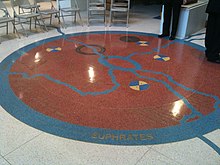
Hughes's ashes are interred under a cosmogram medallion in the foyer of the Arthur Schomburg Heart in Harlem
Sexuality
Some academics and biographers believe that Hughes was homosexual and included homosexual codes in many of his poems, as did Walt Whitman, who, Hughes said, influenced his poetry. Hughes's story "Blest Assurance" deals with a begetter's anger over his son'south effeminacy and "queerness".[37] : 192 [37] : 161 [38] [39] [40] [41] [42] [43] The biographer Aldrich argues that, in order to retain the respect and support of black churches and organizations and avert exacerbating his precarious financial situation, Hughes remained closeted.[44]
Arnold Rampersad, the primary biographer of Hughes, determined that Hughes exhibited a preference for African-American men in his work and life.[45] But, in his biography Rampersad denies Hughes's homosexuality,[46] and concludes that Hughes was probably asexual and passive in his sexual relationships. Hughes did, however, prove a respect and beloved for his boyfriend black homo (and woman). Other scholars debate for his homosexuality: his dearest of black men is evidenced in a number of reported unpublished poems to an alleged black male lover.[47]
Death
On May 22, 1967, Hughes died in the Stuyvesant Polyclinic in New York Urban center at the historic period of 66 from complications subsequently abdominal surgery related to prostate cancer. His ashes are interred beneath a floor medallion in the middle of the foyer in the Schomburg Center for Research in Black Culture in Harlem.[48] It is the entrance to an auditorium named for him.[49] The design on the floor is an African cosmogram entitled Rivers. The title is taken from his poem "The Negro Speaks of Rivers". Inside the heart of the cosmogram is the line: "My soul has grown deep like the rivers".
Career
from "The Negro Speaks of Rivers" (1920)
...
My soul has grown deep similar the rivers.I bathed in the Euphrates when dawns were young.
I built my hut near the Congo and it lulled me to sleep.
I looked upon the Nile and raised the pyramids above it.
I heard the singing of the Mississippi when Abe Lincoln
went downward to New Orleans, and I've seen its dingy
bosom plow all golden in the sunset. ...
—in The Weary Blues (1926)[fifty]
First published in 1921 in The Crisis — official mag of the National Association for the Advancement of Colored People (NAACP) — "The Negro Speaks of Rivers" became Hughes'southward signature poem and was collected in his first book of verse, The Weary Dejection (1926).[51] Hughes's starting time and last published poems appeared in The Crisis; more of his poems were published in The Crisis than in whatever other journal.[52] Hughes' life and work were enormously influential during the Harlem Renaissance of the 1920s, alongside those of his contemporaries, Zora Neale Hurston,[53] Wallace Thurman, Claude McKay, Countee Cullen, Richard Bruce Nugent, and Aaron Douglas. Except for McKay, they worked together also to create the short-lived magazine Fire!! Devoted to Younger Negro Artists.
Hughes and his contemporaries had different goals and aspirations than the black center class. Hughes and his fellows tried to draw the "low-life" in their art, that is, the real lives of blacks in the lower social-economic strata. They criticized the divisions and prejudices within the blackness community based on skin color.[54] Hughes wrote what would be considered their manifesto, "The Negro Artist and the Racial Mount", published in The Nation in 1926:
The younger Negro artists who create at present intend to express our private dark-skinned selves without fright or shame. If white people are pleased we are glad. If they are not, information technology doesn't matter. Nosotros know nosotros are beautiful. And ugly, too. The tom-tom cries, and the tom-tom laughs. If colored people are pleased we are glad. If they are not, their displeasure doesn't matter either. We build our temples for tomorrow, strong as we know how, and we stand on summit of the mountain gratis within ourselves.[55]
His poetry and fiction portrayed the lives of the working-class blacks in America, lives he portrayed as full of struggle, joy, laughter, and music. Permeating his work is pride in the African-American identity and its diverse culture. "My seeking has been to explicate and illuminate the Negro condition in America and obliquely that of all human being kind",[56] Hughes is quoted as proverb. He confronted racial stereotypes, protested social conditions, and expanded African America'due south epitome of itself; a "people's poet" who sought to reeducate both audience and artist by lifting the theory of the black aesthetic into reality.[57]
The night is beautiful,
And then the faces of my people.The stars are beautiful,
So the eyes of my peopleCute, besides, is the sun.
Beautiful, besides, are the souls of my people.
—"My People" in The Crisis (October 1923)[58]
Hughes stressed a racial consciousness and cultural nationalism devoid of self-hate. His thought united people of African descent and Africa beyond the globe to encourage pride in their diverse blackness folk culture and black aesthetic. Hughes was one of the few prominent black writers to champion racial consciousness as a source of inspiration for blackness artists.[59] His African-American race consciousness and cultural nationalism would influence many foreign black writers, including Jacques Roumain, Nicolás Guillén, Léopold Sédar Senghor, and Aimé Césaire. Along with the works of Senghor, Césaire, and other French-speaking writers of Africa and of African descent from the Caribbean area, such as René Maran from Martinique and Léon Damas from French Guiana in Due south America, the works of Hughes helped to inspire the Négritude movement in France. A radical black self-exam was emphasized in the face of European colonialism.[60] [61] In addition to his case in social attitudes, Hughes had an important technical influence by his accent on folk and jazz rhythms as the footing of his poetry of racial pride.[62]
In 1930, his offset novel, Not Without Laughter, won the Harmon Gilt Medal for literature. At a time before widespread arts grants, Hughes gained the support of private patrons and he was supported for ii years prior to publishing this novel.[63] The protagonist of the story is a boy named Sandy, whose family unit must deal with a diversity of struggles due to their race and class, in addition to relating to one another.
In 1931, Hughes helped form the "New York Suitcase Theater" with playwright Paul Peters, creative person Jacob Burck, and author (before long-to-be underground spy) Whittaker Chambers, an acquaintance from Columbia.[64] In 1932, he was part of a lath to produce a Soviet film on "Negro Life" with Malcolm Cowley, Floyd Dell, and Chambers.[64]
In 1931 Prentiss Taylor and Langston Hughes created the Golden Stair Press, issuing broadsides and books featuring the artwork of Prentiss Taylor and the texts of Langston Hughes. In 1932 they issued The Scottsboro Limited based on the trial of the Scottsboro Boys.[65]
In 1932, Hughes and Ellen Winter wrote a pageant to Caroline Decker in an attempt to celebrate her piece of work with the striking coal miners of the Harlan Canton War, merely it was never performed. It was judged to be a "long, artificial propaganda vehicle too complicated and too cumbersome to be performed."[66]
Proverb Lieber became his literary agent, 1933–45 and 1949–50. (Chambers and Lieber worked in the underground together around 1934–35.)[67]

Hughes' first collection of brusk stories was published in 1934 with The Means of White Folks. He finished the book at a Carmel, California cottage provided for a twelvemonth by Noel Sullivan, another patron.[68] [69] These stories are a series of vignettes revealing the humorous and tragic interactions between whites and blacks. Overall, they are marked by a full general pessimism about race relations, besides as a sardonic realism.[seventy] He also became an advisory board member to the (then) newly formed San Francisco Workers' Schoolhouse (afterward the California Labor School).
In 1935, Hughes received a Guggenheim Fellowship. The same yr that Hughes established his theatre troupe in Los Angeles, he realized an ambition related to films by co-writing the screenplay for Way Downward South.[71] Hughes believed his failure to gain more work in the lucrative movie trade was due to racial bigotry inside the manufacture.
In Chicago, Hughes founded The Skyloft Players in 1941, which sought to nurture black playwrights and offer theatre "from the black perspective."[72] Soon thereafter, he was hired to write a column for the Chicago Defender, in which he presented some of his "about powerful and relevant piece of work", giving voice to black people. The cavalcade ran for xx years. In 1943, Hughes began publishing stories most a character he called Jesse B. Semple, often referred to and spelled "Uncomplicated", the everyday black man in Harlem who offered musings on topical issues of the day.[72] Although Hughes seldom responded to requests to teach at colleges, in 1947 he taught at Atlanta University. In 1949, he spent three months at the University of Chicago Laboratory Schools as a visiting lecturer. Between 1942 and 1949, Hughes was a frequent writer and served on the editorial board of Common Ground, a literary magazine focused on cultural pluralism in the United states published past the Common Council for American Unity (CCAU).
He wrote novels, brusque stories, plays, poetry, operas, essays, and works for children. With the encouragement of his all-time friend and author, Arna Bontemps, and patron and friend, Carl Van Vechten, he wrote two volumes of autobiography, The Big Sea and I Wonder as I Wander, besides equally translating several works of literature into English language. With Bontemps, Hughes co-edited the 1949 album The Poesy of the Negro, described by The New York Times equally "a stimulating cross-department of the imaginative writing of the Negro" that demonstrates "talent to the betoken where one questions the necessity (other than for its social evidence) of the specialization of 'Negro' in the title".[73]

From the mid-1950s to the mid-1960s, Hughes' popularity among the younger generation of blackness writers varied even equally his reputation increased worldwide. With the gradual advance toward racial integration, many black writers considered his writings of black pride and its corresponding subject matter out of date. They considered him a racial chauvinist.[74] He establish some new writers, among them James Baldwin, lacking in such pride, over-intellectual in their work, and occasionally vulgar.[75] [76] [77]
Hughes wanted young black writers to exist objective near their race, but not to contemptuousness it or flee information technology.[59] He understood the master points of the Black Ability move of the 1960s, but believed that some of the younger black writers who supported it were too angry in their piece of work. Hughes's work Panther and the Lash, posthumously published in 1967, was intended to testify solidarity with these writers, but with more skill and devoid of the nigh virulent anger and racial chauvinism some showed toward whites.[78] [79] Hughes continued to take admirers among the larger younger generation of blackness writers. He often helped writers by offer advice and introducing them to other influential persons in the literature and publishing communities. This latter group, including Alice Walker, whom Hughes discovered, looked upon Hughes every bit a hero and an example to be emulated within their own piece of work. One of these immature black writers (Loften Mitchell) observed of Hughes:
Langston set a tone, a standard of brotherhood and friendship and cooperation, for all of the states to follow. You lot never got from him, 'I am the Negro writer,' only only 'I am a Negro writer.' He never stopped thinking about the rest of us.[fourscore]
Political views
Hughes was fatigued to Communism as an alternative to a segregated America.[81] Many of his bottom-known political writings have been collected in two volumes published past the Academy of Missouri Press and reflect his attraction to Communism. An example is the poem "A New Song".[82] [ original research? ]
In 1932, Hughes became function of a grouping of blackness people who went to the Soviet Union to make a movie depicting the plight of African Americans in the United states of america. The film was never fabricated, but Hughes was given the opportunity to travel extensively through the Soviet Wedlock and to the Soviet-controlled regions in Central Asia, the latter parts ordinarily closed to Westerners. While there, he met Robert Robinson, an African American living in Moscow and unable to get out. In Turkmenistan, Hughes met and befriended the Hungarian author Arthur Koestler, then a Communist who was given permission to travel there.[83]
As after noted in Koestler's autobiography, Hughes, together with some forty other Black Americans, had originally been invited to the Soviet Union to produce a Soviet film on "Negro Life",[84] but the Soviets dropped the motion picture thought because of their 1933 success in getting the US to recognize the Soviet Union and establish an diplomatic mission in Moscow. This entailed a toning down of Soviet propaganda on racial segregation in America. Hughes and his fellow Blacks were not informed of the reasons for the cancelling, but he and Koestler worked it out for themselves.[85]
Hughes also managed to travel to China,[86] Nihon,[87] and Korea[88] before returning to united states of america.
Hughes's poetry was frequently published in the CPUSA newspaper and he was involved in initiatives supported by Communist organizations, such as the drive to complimentary the Scottsboro Boys. Partly every bit a testify of support for the Republican faction during the Castilian Civil State of war,[ commendation needed ] in 1937 Hughes traveled to Spain[89] every bit a contributor for the Baltimore Afro-American and other various African-American newspapers. In Baronial 1937, he broadcast live from Madrid alongside Harry Haywood and Walter Benjamin Garland. Hughes was also involved in other Communist-led organizations such as the John Reed Clubs and the League of Struggle for Negro Rights. He was more of a sympathizer than an agile participant. He signed a 1938 statement supporting Joseph Stalin'due south purges and joined the American Peace Mobilization in 1940 working to keep the U.S. from participating in Earth State of war II.[90] [ not-primary source needed ]
Hughes initially did not favor blackness American interest in the war because of the persistence of discriminatory U.Southward. Jim Crow laws and racial segregation and disfranchisement throughout the Southward. He came to support the war effort and black American participation later on deciding that war service would assist their struggle for civil rights at home.[91] The scholar Anthony Pinn has noted that Hughes, together with Lorraine Hansberry and Richard Wright, was a humanist "critical of belief in God. They provided a foundation for nontheistic participation in social struggle." Pinn has found that such writers are sometimes ignored in the narrative of American history that chiefly credits the civil rights movement to the piece of work of affiliated Christian people.[92]
Hughes was defendant of beingness a Communist by many on the political right, but he always denied it. When asked why he never joined the Communist Party, he wrote, "information technology was based on strict discipline and the credence of directives that I, equally a writer, did not wish to accept." In 1953, he was called earlier the Senate Permanent Subcommittee on Investigations led by Senator Joseph McCarthy. He stated, "I never read the theoretical books of socialism or communism or the Democratic or Republican parties for that matter, so my involvement in whatever may exist considered political has been not-theoretical, not-sectarian, and largely emotional and built-in out of my ain need to find some way of thinking virtually this whole trouble of myself."[93] Post-obit his testimony, Hughes distanced himself from Communism.[94] He was rebuked by some on the Radical Left who had previously supported him. He moved away from overtly political poems and towards more lyric subjects. When selecting his poetry for his Selected Poems (1959) he excluded all his radical socialist verse from the 1930s.[94] These critics on the Left were unaware of the surreptitious interrogation that took place days earlier the televised hearing.[95]
Representation in other media

Hughes was featured reciting his poetry on the album Weary Blues (MGM, 1959), with music past Charles Mingus and Leonard Plumage, and he besides contributed lyrics to Randy Weston's Uhuru Afrika (Roulette, 1960).
Composer Mira Pratesi Sulpizi ready Hughes' text to music in her 1968 song "Lyrics."[96]
Hughes' life has been portrayed in film and stage productions since the late 20th century. In Looking for Langston (1989), British filmmaker Isaac Julien claimed him equally a black gay icon — Julien thought that Hughes' sexuality had historically been ignored or downplayed. Flick portrayals of Hughes include Gary LeRoi Gray'south function as a teenage Hughes in the short bailiwick film Conservancy (2003) (based on a portion of his autobiography The Big Sea), and Daniel Sunjata equally Hughes in the Blood brother to Blood brother (2004). Hughes' Dream Harlem, a documentary by Jamal Joseph, examines Hughes' works and surroundings.
Paper Armor (1999) past Eisa Davis and Hannibal of the Alps (2005)[97] by Michael Dinwiddie are plays by African-American playwrights that address Hughes'south sexuality. Spike Lee'due south 1996 flick Get on the Bus, included a black gay character, played past Isaiah Washington, who invokes the name of Hughes and punches a homophobic grapheme, proverb: "This is for James Baldwin and Langston Hughes."
Hughes was besides featured prominently in a national campaign sponsored by the Center for Inquiry (CFI) known every bit African Americans for Humanism.[98]
Hughes' Ask Your Mama: 12 Moods for Jazz, written in 1960, was performed for the kickoff time in March 2009 with specially equanimous music by Laura Karpman at Carnegie Hall, at the Accolade festival curated by Jessye Norman in celebration of the African-American cultural legacy.[99] Ask Your Mama is the centerpiece of "The Langston Hughes Project",[100] a multimedia concert functioning directed by Ron McCurdy, professor of music in the Thornton Schoolhouse of Music at the University of Southern California.[101] The European premiere of The Langston Hughes Project, featuring Ice-T and McCurdy, took identify at the Barbican Centre, London, on November 21, 2015, as part of the London Jazz Festival mounted past music producers Serious.[102] [103]
The novel Harlem Mosaics (2012) by Whit Frazier depicts the friendship between Langston Hughes and Zora Neale Hurston, and tells the story of how their friendship savage apart during their collaboration on the play Mule Bone.[104]
On September 22, 2016, his verse form "I, Besides" was printed on a full page of The New York Times in response to the riots of the previous twenty-four hour period in Charlotte, N Carolina.[105]
Literary archives
The Beinecke Rare Book and Manuscript Library at Yale University holds the Langston Hughes papers (1862–1980) and the Langston Hughes collection (1924–1969) containing letters, manuscripts, personal items, photographs, clippings, artworks, and objects that document the life of Hughes. The Langston Hughes Memorial Library on the campus of Lincoln University, also as at the James Weldon Johnson Collection within the Yale University likewise hold athenaeum of Hughes' work.[106] The Moorland-Spingarn Research Center at Howard University includes materials acquired from his travels and contacts through the work of Dorothy B. Porter.[107]
Honors and awards
Living
- 1926: Hughes won the Witter Bynner Undergraduate Poetry Prize.[108]
- 1935: Hughes was awarded a Guggenheim Fellowship, which allowed him to travel to Spain and Russian federation.
- 1941: Hughes was awarded a fellowship from the Rosenwald Fund.
- 1943: Lincoln University awarded Hughes an honorary Litt.D.
- 1954: Hughes won the Anisfield-Wolf Book Laurels.
- 1960: the NAACP awarded Hughes the Spingarn Medal for distinguished achievements by an African American.
- 1961: National Institute of Arts and Letters.[109]
- 1963: Howard University awarded Hughes an honorary doctorate.
- 1964: Western Reserve Academy awarded Hughes an honorary Litt.D.
Memorial
- 1973: the offset Langston Hughes Medal was awarded by the City College of New York.
- 1979: Langston Hughes Middle Schoolhouse was created in Reston, Virginia.
- 1981: New York City Landmark condition was given to the Harlem home of Langston Hughes at 20 Due east 127th Street ( twoscore°48′26.32″Northward 73°56′25.54″W / 40.8073111°North 73.9404278°West / 40.8073111; -73.9404278 ) by the New York City Landmarks Preservation Commission and 127th Street was renamed "Langston Hughes Place".[110] The Langston Hughes House was listed on the National Register of Historic Places in 1982.[111]
- 2002: The United States Postal Service added the prototype of Langston Hughes to its Blackness Heritage series of postage stamps.
- 2002: scholar Molefi Kete Asante listed Langston Hughes on his listing of 100 Greatest African Americans.[112]
- 2009: Langston Hughes High School was created in Fairburn, Georgia.
- 2012: inducted into the Chicago Literary Hall of Fame.[113]
- 2015: Google Putter commemorated his 113th birthday.[114]
Bibliography
Poesy collections
Novels and curt story collections
|
Non-fiction books
Major plays
Books for children
Every bit editor
|
Other writings
- The Langston Hughes Reader, New York: Braziller, 1958.
- Good Morning time Revolution: Uncollected Social Protestation Writings by Langston Hughes, Lawrence Hill, 1973.
- The Collected Works of Langston Hughes, Missouri: Academy of Missouri Press, 2001.
- The Selected Messages of Langston Hughes, edited by Arnold Rampersad and David Roessel. Knopf, 2014.
- "My Adventures equally a Social Poet" (essay), Phylon, 3rd Quarter 1947.
- "The Negro Artist and The Racial Mountain" (article), The Nation, June 23, 1926.
See also
- African-American literature
- Langston Hughes Society
- Pan-Africanism
Notes
- ^ Schuessler, Jennifer. "Langston Hughes Just Got a Twelvemonth Older". The New York Times . Retrieved Baronial 9, 2018.
- ^ Francis, Ted (2002). Realism in the Novels of the Harlem Renaissance.
- ^ Langston Hughes (1940). The Big Sea. p. 36. ISBN0-8262-1410-10.
- ^ a b Faith Berry, Langston Hughes, Before and Beyond Harlem, Westport, CT: Lawrence Colina & Co., 1983; reprint, Citadel Press, 1992, p. 1.
- ^ "The oft-told tale". Frankel and Fisch. July 15, 2015. Retrieved February 9, 2022.
- ^ a b Richard B. Sheridan, "Charles Henry Langston and the African American Struggle in Kansas", Kansas State History, Wintertime 1999. Retrieved December 15, 2008.
- ^ Laurie F. Leach, Langston Hughes: A Biography, Greenwood Publishing Grouping, 2004, pp. 2–iv. ISBN 9780313324970,
- ^ "Ohio Anti-Slavery Social club – Ohio History Central". ohiohistorycentral.org.
- ^ "African-Native American Scholars". African-Native American Scholars. 2008. Retrieved July 30, 2008.
- ^ William and Aimee Lee Cheek, "John Mercer Langston: Principle and Politics", in Leon F. Litwack and Baronial Meier (eds), Black Leaders of the Nineteenth Century, University of Illinois Printing, 1991, pp. 106–111.
- ^ Langston Hughes (1940). The Big Sea. p. 13. ISBN0-8262-1410-X.
- ^ Westward, Encyclopedia of the Harlem Renaissance, 2003, p. 160.
- ^ Hughes recalled his maternal grandmother's stories: "Through my grandmother'due south stories life ever moved, moved heroically toward an end. Nobody ever cried in my grandmother'southward stories. They worked, schemed, or fought. Simply no crying." Rampersad, Arnold, & David Roessel (2002). The Collected Poems of Langston Hughes, Knopf, p. 620.
- ^ The poem "Aunt Sues'due south Stories" (1921) is an oblique tribute to his grandmother and his loving "Auntie" Mary Reed, a shut family unit friend. Rampersad, vol. 1, 1986, p. 43.
- ^ Brooks, Gwendolyn (October 12, 1986), "The Darker Brother", The New York Times.
- ^ Arnold Rampersad, The Life of Langston Hughes: Book 2: 1914–1967, I Dream a Earth, Oxford University Printing, p. 11. ISBN 9780195146431
- ^ Central High Schoolhouse (Cleveland, Ohio); Wirth, Thomas H.; Hughes, Langston; Thomas H. Wirth Collection (Emory Academy. MARBL) (Feb 1, 2019). "The Key High School monthly". Primal Loftier. Retrieved Feb 1, 2019 – via Hathi Trust.
- ^ "Ronnick: Inside CAMWS Territory: Helen M. Chesnutt (1880–1969), Blackness Latinist". Camws.org . Retrieved Feb 1, 2019.
- ^ Langston Hughes Reads His Poetry, with commentary, audiotape from Caedmon Audio
- ^ "Langston Hughes, Writer, 65, Dead". The New York Times. May 23, 1967.
- ^ "Langston Hughes | Scholastic". www.scholastic.com . Retrieved June 20, 2017.
- ^ "Langston Hughes biography: African-American history: Crossing Boundaries: Kansas Humanities Quango". www.kansasheritage.org . Retrieved June 20, 2017.
- ^ Langston Hughes (1940). The Large Sea, pp. 54–56.
- ^ Brooks, Gwendolyn (October 12, 1986). "Review of The Darker Brother". The New York Times. New York City.
And the father, Hughes said, 'hated Negroes. I think he hated himself, likewise, for being a Negro. He disliked all of his family because they were Negroes.' James Hughes was tightfisted, uncharitable, common cold.
- ^ Wallace, Maurice Orlando (2008). Langston Hughes: The Harlem Renaissance. Marshall Cavendish. ISBN978-0-7614-2591-5.
- ^ "Write Columbia's History". c250.columbia.edu . Retrieved February 11, 2022.
- ^ Rampersad, vol. one, 1986, p. 56.
- ^ "Verse form" or "To F.S." commencement appeared in The Crisis in May 1925, and was reprinted in The Weary Blues and The Dream Keeper. Hughes never publicly identified "F.S.", but information technology is conjectured he was Ferdinand Smith, a merchant seaman whom the poet first met in New York in the early 1920s. 9 years older than Hughes, Smith influenced the poet to go to ocean. Built-in in Jamaica in 1893, Smith spent most of his life every bit a ship steward and political activist at ocean—and later in New York as a resident of Harlem. Smith was deported in 1951 to Jamaica for alleged Communist activities and illegal alien status. Hughes corresponded with Smith upwardly until the latter'southward expiry in 1961. Drupe, p. 347.
- ^ "Langston Hughes". Biography.com . Retrieved June xx, 2017.
- ^ Leach, Langston Hughes: A Biography (2004), pp. sixteen, 153.
- ^ Rampersad, Vol. 1, pp. 86–87, 89–90.
- ^ "History – Hugh Wooding Constabulary School". Hwls.edu.tt.
- ^ In 1926, Amy Spingarn, wife of Joel Elias Spingarn, who was president of the National Association for the Advancement of Colored People (NAACP), served every bit patron for Hughes and provided the funds ($300) for him to nourish Lincoln University. Rampersad, vol. 1, 1986, pp. 122–23.
- ^ In November 1927, Charlotte Osgood Mason ("Godmother" equally she liked to be called), became Hughes'due south major patron. Rampersad. vol. ane, 1986, p. 156.
- ^ "Mule Bone: Langston Hughes and Zora Neale Hurston's Dream Deferred of an African-American Theatre of the Black Word.", African American Review, March 22, 2001. Retrieved March 7, 2008. "In February 1930, Hurston headed north, settling in Westfield, New Jersey. Godmother Stonemason (Mrs. Rufus Osgood Mason, their white protector) had selected Westfield, safely removed from the distractions of New York City, as a suitable identify for both Hurston and Hughes to work."
- ^ "J. L. Hughes Will Depart Afterward Questioning as to Communism", The New York Times, July 25, 1933.
- ^ a b Nero, Charles I. (1997), "Re/Membering Langston", in Martin Duberman (ed.), Queer Representations: Reading Lives, Reading Cultures, New York University Press, ISBN 978-0-81471-884-1
- ^ Yale Symposium, Was Langston Gay? commemorating the 100th birthday of Hughes in 2002.
- ^ Schwarz, pp. 68–88.
- ^ Although Hughes was extremely closeted, some of his poems may hint at homosexuality. These include: "Joy", "Desire", "Cafe: 3 A.M.", "Waterfront Streets", "Immature Sailor", "Trumpet Player", "Tell Me", "F.S." and some poems in Montage of a Dream Deferred. LGBTQQ History Archived May nineteen, 2013, at the Wayback Car, Iowa Pride Network. Retrieved June 23, 2014.
- ^ "Cafe 3 A.One thousand." was confronting gay bashing by police, and "Verse form for F.Southward." was about his friend Ferdinand Smith. Nero, Charles I. (1999), p. 500.
- ^ Jean Blackwell Hutson, onetime chief of the Schomburg Heart for Research in Black Civilisation, said: "He was e'er eluding marriage. He said marriage and career didn't work. ... It wasn't until his later years that I became convinced he was homosexual." Hutson & Nelson, Essence, Feb 1992, p. 96.
- ^ McClatchy, J. D. (2002). Langston Hughes: Vox of the Poet. New York: Random House Sound. p. 12. ISBN978-0-55371-491-3.
Though there were exceptional and half-hearted affairs with women, most people considered Hughes asexual, insistent on a skittish, carefree 'innocence.' In fact, he was a closeted homosexual.
- ^ Aldrich (2001), p. 200.
- ^ Referring to men of African descent, Rampersad writes: "... Hughes found some young men, especially dark-skinned men, appealing and sexually fascinating. (Both in his various artistic representations, in fiction especially, and in his life, he appears to have found young white men of niggling sexual entreatment.) Virile immature men of very dark complexion fascinated him." Rampersad, vol. 2, 1988, p. 336.
- ^ "His fatalism was well placed. Nether such pressure, Hughes's sexual desire, such as it was, became not so much sublimated as vaporized. He governed his sexual desires to an extent rare in a normal adult male person; whether his appetite was normal and developed is impossible to say. He understood, all the same, that Cullen and Locke offered him nil he wanted, or nothing that promised much for him or his poetry. If sure of his responses to Locke seemed like teasing (a habit Hughes would never quite lose with women, or, mayhap, men) they were non therefore necessarily signs of sexual desire; more likely, they showed the lack of it. Nor should ane infer quickly that Hughes was held dorsum by a greater fright of public exposure every bit a homosexual than his friends had; of the three men, he was the but 1 ready, indeed eager, to be perceived as disreputable." "Rampersad, The Life of Langston Hughes, Vol. I, p. 69.
- ^ Sandra West states: Hughes's "apparent beloved for black men equally evidenced through a serial of unpublished poems he wrote to a black male person lover named 'Beauty'." West, 2003, p. 162.
- ^ Wilson, Scott (2016). Resting Places: The Burial Sites of More than Than fourteen,000 Famous Persons. Jefferson, Due north Carolina: McFarland & Company. p. 359. ISBN978-0786479924.
- ^ Whitaker, Charles, "Langston Hughes: 100th altogether celebration of the poet of Black America", Ebony, Apr 2002.
- ^ "The Negro Speaks of Rivers" Archived July 26, 2010, at the Wayback Machine. Audio file, Hughes reading. Verse form information from Poets.org.
- ^ "The Negro Speaks of Rivers": first published in The Crunch (June 1921), p. 17. Included in The New Negro (1925), The Weary Blues, Langston Hughes Reader, and Selected Poems. The poem is dedicated to West. E. B. Du Bois in The Weary Blues, merely it is printed without dedication in subsequently versions. — Rampersad & Roessel (2002). In The Collected Poems of Langston Hughes, pp. 23, 620.
- ^ Rampersad & Roessel (2002), The Nerveless Poems of Langston Hughes, pp. 23, 620.
- ^ Hoelscher, Stephen (2019). "A Lost Work by Langston Hughes". Smithsonian . Retrieved May 10, 2021.
- ^ Hughes "disdained the rigid class and colour differences the 'best people' drew between themselves and Afro-Americans of darker complexion, of smaller means and lesser formal didactics." — Berry, 1983 & 1992, p. 60.
- ^ "The Negro Artist and the Racial Mountain" (June 1926), The Nation.
- ^ Rampersad, 1988, vol. 2, p. 418.
- ^ West, 2003, p. 162.
- ^ "My People" First published as "Verse form" in The Crisis (October 1923), p. 162, and The Weary Blues (1926). The championship poem "My People" was collected in The Dream Keeper (1932) and the Selected Poems of Langston Hughes (1959). Rampersad & Roessel (2002), The Nerveless Poems of Langston Hughes, pp. 36, 623.
- ^ a b Rampersad. vol. ii, 1988, p. 297.
- ^ Rampersad. vol. one, 1986, p. 91.
- ^ Mercer Melt, African-American scholar of French civilisation wrote: "His (Langston Hughes) work had a lot to do with the famous concept of Négritude, of blackness soul and feeling, that they were start to develop." Rampersad, vol. ane, 1986, p. 343.
- ^ Rampersad. vol. i, 1986, p. 343.
- ^ Charlotte Mason generously supported Hughes for two years. She supervised his writing his start novel, Not Without Laughter (1930). Her patronage of Hughes concluded most the time the novel appeared. Rampersad. "Langston Hughes", in The Concise Oxford Companion to African American Literature, 2001, p. 207.
- ^ a b Tanenhaus, Sam (1997). Whittaker Chambers: A Biography. Random House. ISBN9780307789266.
- ^ millersvillearchives Gold Stair Press
- ^ Anne Loftis (1998), Witnesses to the Struggle, p. 46, Academy of Nevada Press, ISBN 978-0-87417-305-5.
- ^ Chambers, Whittaker (1952). Witness. New York: Random House. pp. 44–45 (includes description of Lieber), 203, 266fn, 355, 365, 366, 388, 376–377, 377fn, 394, 397, 401, 408, 410. LCCN 52005149.
- ^ Noel Sullivan, after working out an agreement with Hughes, became a patron for him in 1933. — Rampersad, vol. 1, 1986, p. 277.
- ^ Sullivan provided Hughes with the opportunity to consummate The Ways of White Folks (1934) in Carmel, California. Hughes stayed a year in a cottage Sullivan provided. — Rampersad, "Langston Hughes". In The Curtailed Oxford Companion to African American Literature, 2001, p. 207.
- ^ Rampersad (2001) Langston Hughes, p. 207.
- ^ Co-written with Clarence Muse, African-American Hollywood actor and musician. — Rampersad. vol. i, 1986, pp. 366–69.
- ^ a b "Langston Hughes". Chicago Literary Hall of Fame. Chicago Writers Clan. Archived from the original on September viii, 2013. Retrieved June 11, 2013.
- ^ Creekmore, Hubert (January 30, 1949). "2 Rewarding Volumes of Verse; ONE-Fashion TICKET. By Langston Hughes. Illustrated past Jacob Lawrence. 136 pp. New York: Alfred A. Knopf. $ii.75. THE POETRY OF THE NEGRO: 1746–1949. Edited by Arna Bontemps and Langston Hughes. 429 pp. New York: Doubleday & Co. $5". The New York Times. p. xix.
- ^ Rampersad, 1988, vol. 2, p. 207.
- ^ Langston'south misgivings about the new black writing were because of its emphasis on black criminality and frequent use of profanity. — Rampersad, vol. two, p. 207.
- ^ Hughes said: "In that location are millions of blacks who never murder anyone, or rape or go raped or want to rape, who never lust later white bodies, or cringe before white stupidity, or Uncle Tom, or go crazy with race, or off-balance with frustration." — Rampersad, vol. 2, p. 119.
- ^ Langston eagerly looked to the day when the gifted young writers of his race would go beyond the bedlam of civil rights and integration and have a genuine pride in beingness black ... he found this latter quality starkly absent in even the all-time of them. — Rampersad, vol. 2, p. 310.
- ^ "As for whites in general, Hughes did not like them ... He felt he had been exploited and humiliated by them." — Rampersad, 1988, vol. ii, p. 338.
- ^ Hughes's advice on how to deal with racists was, "'E'er exist polite to them ... be over-polite. Kill them with kindness.' But, he insisted on recognizing that all whites are not racist, and definitely enjoyed the company of those who sought him out in friendship and with respect." — Rampersad, 1988, vol. 2, p. 368.
- ^ Rampersad, 1988, vol. 2, p. 409.
- ^ Fountain, James (June 2009). "The notion of cause in British and American literary responses to the Spanish Civil War". Journal of Transatlantic Studies. seven (two): 133–147. doi:x.1080/14794010902868298. S2CID 145749786.
- ^ The stop of "A New Song" was essentially changed when it was included in A New Song (New York: International Workers Order, 1938).
- ^ Scammell, Michael. "Langston Hughes in the USSR". New York Review of Books. ISSN 0028-7504. Retrieved February 20, 2021.
- ^ Tanenhaus, Sam (1997). Whittaker Chambers: A Biography. Random Business firm. ISBN9780307789266. Malcolm Cowley, Floyd Dell, and Chambers were also involved in this intended film.
- ^ Arthur Koestler, "The Invisible Writing", Ch. 10.
- ^ Lai-Henderson, Selina (2020). "Colour around the Globe: Langston Hughes and Black Internationalism in Mainland china". MELUS. 45 (2): 88–107. doi:10.1093/melus/mlaa016.
- ^ Kiuchi, Toru (2008). "The Disquisitional Response in Nippon to Langston Hughes" (PDF). Nihon daigaku seisan kōgakubu kenkyū hōkoku B 日本大学生産工学部研究報告B. 41: 1–14.
- ^ Huh, Jang Wook (2021). "'Our Temples for Tomorrow': Langston Hughes and the Making of a Democratic Korea". The Langston Hughes Review. 27 (two): 115–136. doi:x.5325/langhughrevi.27.ii.0115.
- ^ "Abraham Lincoln Brigade Archives". Alba-valb.org . Retrieved July 24, 2010.
- ^ Langston Hughes (2001), Fight for Freedom and Other Writings, University of Missouri Press, p. 9.
- ^ Rampersad, Arnold (2002). The Life of Langston Hughes: Volume II: 1941–1967, I Dream a World. Oxford University Printing. p. 85. ISBN978-0-xix-988227-four.
- ^ Winston, Kimberly (February 22, 2012). "Blacks say atheists were unseen ceremonious rights heroes". The Washington Post. Faith News Service.
- ^ Executive Sessions of the Senate Permanent Subcommittee on Investigations of the Committee on Government Operations, Volume 2, Volume 107, Issue 84 of S. prt, Beth Bolling, ISBN 9780160513626. Permanent Subcommittee on Investigations, Publisher: U.South. GPO. Original from the Academy of Michigan p. 988.
- ^ a b Leach, Langston Hughes: A Biography (2004), pp. 118–119.
- ^ Sharf, James C. (1981). "Testimony of Richard T. Seymour, before the Subcommittee on the Constitution, Senate Committee on the Judiciary". doi:10.1037/e578982009-004.
- ^ Cohen, Aaron I. (1987). International Encyclopedia of Women Composers. Books & Music (The states). ISBN978-0-9617485-ii-4.
- ^ Donald V. Calamia, "Review: 'Hannibal of the Alps'". Archived Nov 22, 2015, at the Wayback Machine. Pride Source, from Between The Lines, June nine, 2005.
- ^ "We are African Americans for Humanism". African Americans for Humanism . Retrieved February two, 2015.
- ^ Jeff Lunden, "'Ask Your Mama': A Music And Poetry Premiere", NPR.
- ^ "THE LANGSTON HUGHES Project". Ronmccurdy.com.
- ^ "Ronald C. McCurdy, Ph.D." Biography.
- ^ "Water ice-T and Ron McCurdy – the Langston Hughes Project". Archived November 22, 2015, at the Wayback Auto, Artform press releases.
- ^ "The Langston Hughes Projection, Thursday 24 September 2015", Serious. Article past Margaret Busby, showtime published in the Barbican November 2015 Guide.
- ^ "Fiction Volume Review: Harlem Mosaics". Publishers Weekly. April 28, 2018.
- ^ Maddie Crum (September 22, 2016). "Powerful Poem Most Race Gets A Full Folio In The New York Times". Huffington Post.
- ^ "Langston Hughes Memorial Library". Lincoln Academy. Retrieved November 13, 2013.
- ^ Nunes, Zita Cristina (November xx, 2018). "Cataloging Black Knowledge: How Dorothy Porter Assembled and Organized a Premier Africana Inquiry Drove". Perspectives on History . Retrieved Nov 24, 2018.
- ^ "Langston Hughes, Poet". The Los Angeles Times. Los Angeles. September 26, 1926. p. 66. Retrieved January 7, 2021.
The Witter Bynner undergraduate poetry prize for 1926 was awarded to Langston Hughes, Lincoln Academy, whom Carl Van Vechten ranks with among the best of the younger American poets.
- ^ "Langston Hughes — Poet". h2g2: The Hitchhiker's Guide to the Galaxy. Retrieved July 24, 2010.
- ^ Jen Carlson (June xviii, 2007)."Langston Hughes Lives On In Harlem", Archived February 2, 2008, at the Wayback Machine, Gothamist. Retrieved November 22, 2015.
- ^ "National Register Information System". National Register of Historic Places. National Park Service. March thirteen, 2009.
- ^ Asante, Molefi Kete (2002). 100 Greatest African Americans: A Biographical Encyclopedia. Amherst, New York: Prometheus Books. ISBN 1-57392-963-8.
- ^ "Langston Hughes". Chicago Literary Hall of Fame. 2012. Retrieved Oct 8, 2017.
- ^ "Langston Hughes' 113th Birthday". Google.com.
References
- Aldrich, Robert (2001). Who's Who in Gay & Lesbian History, Routledge. ISBN 0-415-22974-10
- Bernard, Emily (2001). Retrieve Me to Harlem: The Letters of Langston Hughes and Carl Van Vechten, 1925–1964, Knopf. ISBN 0-679-45113-7
- Drupe, Organized religion (1983.1992,). "Langston Hughes: Before and Beyond Harlem". In On the Cross of the Due south, Citadel Press, p. 150; & Zero Hr, pp. 185–186. ISBN 0-517-14769-vi
- Chenrow, Fred; Chenrow, Ballad (1973). Reading Exercises in Black History, Volume 1, Elizabethtown, PA: The Continental Press, Inc. p. 36. ISBN 08454-2107-7.
- Hughes, Langston (2001). "Fight for Liberty and Other Writings on Civil Rights" (Collected Works of Langston Hughes, Vol. 10). In Christopher C. DeSantis (ed.). Introduction, p. 9. University of Missouri Printing. ISBN 0-8262-1371-five
- Hutson, Jean Blackwell; & Jill Nelson (Feb 1992). "Remembering Langston", Essence, p. 96.
- Joyce, Joyce A. (2004). "A Historical Guide to Langston Hughes". In Steven C. Tracy (ed.), Hughes and Twentieth-Century Genderracial Issues, Oxford University Press, p. 136. ISBN 0-19-514434-1
- Nero, Charles I. (1997). "Re/Membering Langston: Homphobic Textuality and Arnold Rampersad's Life of Langston Hughes". In Martin Duberman (ed.), Queer Representations: Reading Lives, Reading Cultures, New York University Printing, p. 192. ISBN 0-8147-1884-i
- Nero, Charles I. (1999). "Free Oral communication or Detest Oral communication: Pornography and its Means of Production". In Larry P. Gross & James D. Woods (eds), Columbia Reader on Lesbians and Gay Men in Media, Society, and Politics, Columbia University Press, p. 500. ISBN 0-231-10447-2
- Nichols, Charles H. (1980). Arna Bontempts-Langston Hughes Letters, 1925–1967, Dodd, Mead & Company. ISBN 0-396-07687-iv
- Ostrom, Hans (1993). Langston Hughes: A Study of the Short Fiction, New York: Twayne. ISBN 0-8057-8343-1
- Ostrom, Hans (2002). A Langston Hughes Encyclopedia, Westport: Greenwood Press. ISBN 0-313-30392-4
- Rampersad, Arnold (1986). The Life of Langston Hughes, Volume 1: I, Too, Sing America, Oxford University Press. ISBN 0-19-514642-five
- Rampersad, Arnold (1988). The Life of Langston Hughes, Volume 2: I Dream A World. Oxford University Press. ISBN 0-19-514643-3
- Schwarz, Christa A. B. (2003). "Langston Hughes: A true 'people's poet'". In Gay Voices of the Harlem Renaissance, Indiana Academy Press, pp. 68–88. ISBN 0-253-21607-ix
- Due west, Sandra Fifty. (2003). "Langston Hughes". In Aberjhani & Sandra West (eds), Encyclopedia of the Harlem Renaissance, Checkmark Printing, p. 162. ISBN 0-8160-4540-2
External links
- Langston Hughes on Poets.org With poems, related essays, and links.
- Profile and poems of Langston Hughes, including sound files and scholarly essays, at the Poetry Foundation.
- Cary Nelson, "Langston Hughes (1902–1967)". Contour at Modern American Poetry.
- Beinecke Library, Yale. "Langston Hughes at 100".
- Contour at Library of Congress.
Archives
- Langston Hughes Papers. James Weldon Johnson Collection in the Yale Collection of American Literature, Beinecke Rare Book and Manuscript Library.
- Langston Hughes Papers at the Wisconsin Centre for Film and Theater Enquiry
- Resources at Library of Congress including audio.
- Representative Poesy Online, University of Toronto
- Works past Langston Hughes at Project Gutenberg
- Works by Langston Hughes at Faded Page (Canada)
- Works past or about Langston Hughes at Internet Archive
- Works by Langston Hughes at LibriVox (public domain audiobooks)

- Langston Hughes collection from the Billops-Hatch Athenaeum, 1926–2002
- Langston Hughes collection from the Raymond Danowski Poetry Library, 1932–1969
- Thyra Edwards' collection of Langston Hughes material, 1935–1941
Source: https://en.wikipedia.org/wiki/Langston_Hughes
0 Response to "What's the Synopsis of a Letter to My Mother That She Will Never Read Ocean Vogue"
Post a Comment