How Do You Know the Butterfly Is in the Vein
The Butterflies That Hear With Their Wings
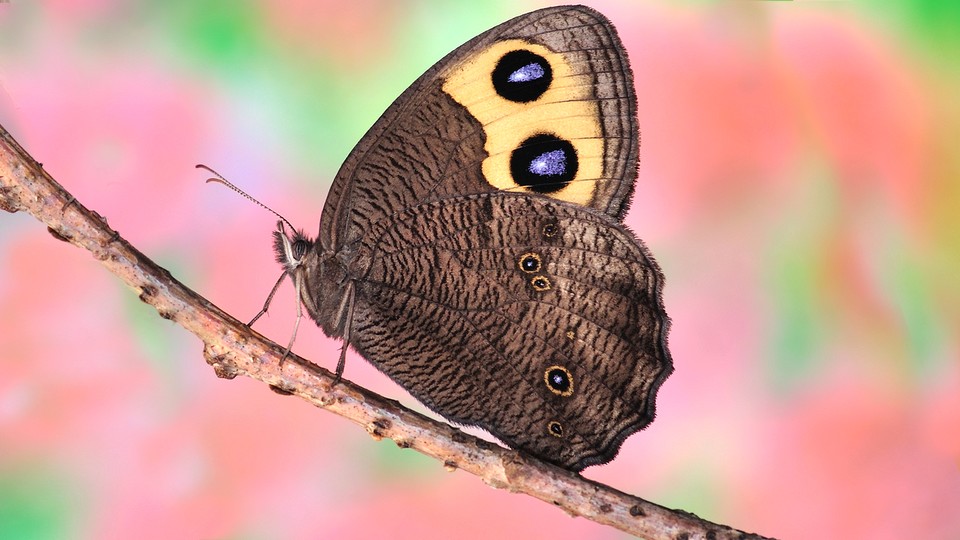
A petite grouping called the satyrines uses swollen veins to channel audio into tiny ears.
When Jayne Yack speaks, she knows that her collywobbles can hear her. They're listening with their wings.
Yack, a professor at Carleton University, studies a group of collywobbles called nymphalids, which include well-known species like monarchs, morphos, emperors, and admirals. Many members of this group have ears at the base of their wings. If one lifted its summit pair of wings in the air, "the ear would exist in what you lot remember of as the armpit," Yack says.
The ears consist of membranes that are stretched taut over oval holes, and that vibrate when incoming sounds hit them. Those vibrations trigger electric signals in the insects' nerves, which Yack tin record. In this fashion, she has shown that the ears are specially sensitive to low frequencies, like those found in human being speech. "When we're recording from a butterfly and we're talking, its fretfulness are merely firing like crazy," she says. "Moths don't hear us; they're tuned to high frequencies. But butterflies tin."
Over the years, Yack noticed that one grouping of nymphalids—the satyrines, or browns—has weird veins on the top pair of wings. Veins are mutual to all butterfly wings; they're air-filled tubes that don't carry blood, merely instead provide structural support. They're usually very thin, but the satyrines have one on each wing that's bizarrely bloated, like a single piece of penne on a plate of spaghetti. Scientists take described these inflated veins before, but Yack noted that they lie very close to the satyrines' ears. Maybe, she suspected, they aid the insects hear.
To test that idea, she sent specimens of the common forest nymph to Natasha Mhatre at the University of Toronto, who studies audio-visual advice in insects. She played noises at the butterflies' ears while shining lasers on them. By analyzing the reflected light amplification by stimulated emission of radiation light, she could work out how much the ears move in response to dissimilar sounds. "We can get a pretty adept appreciation of what the butterfly is hearing," Yack says.
These experiments revealed that the veins are, in outcome, part of the ears. When Mhatre cut them open, the ears became less sensitive in general, and to low-pitched sounds in detail. In the same way that our fleshy outer ears gather sounds and focus them toward our eardrums, the common wood nymph's swollen veins focus sounds onto their ears.
That's useful considering these butterflies are very modest—only a couple of inches from wing tip to wing tip. Small membranes aren't very practiced at detecting depression-pitched sounds, or at working out where those sounds are coming from. The veins seemingly compensate for this problem. "They're hearing aids for minor butterflies," Yack says.
This is a new means of hearing that had never been described before, says Fernando Montealegre-Z of the Academy of Lincoln: "I recall that during my entomology preparation, back in the '90s, we were told that satyrine butterflies could be identified past the bloated vein. Nosotros didn't know why this vein was swollen, and I would have loved to have heard an explanation."
Insects have actually gone to town on the evolution of interesting ears. There are species with ears on their torsos, antennae, wings, knees, and legs. And in about cases, scientists know very little most how these organs work.
For example, why would butterflies demand to hear low frequencies in the first identify? Well-nigh collywobbles are silent, so they're certainly not listening to one another. "We don't actually accept answers," Yack says, "but the most convincing hypothesis is that they're listening to the incidental noises that predators make." They could be listening for flapping wings, or feet stepping on branches, or feathers rustling through grass. It's maybe telling, Yack says, that butterflies are sensitive to the aforementioned low pitches every bit rabbits, lizards, and other small prey animals.
But satyrine hearing is unusual in one crucial way. Across the animal kingdom, virtually ears are tuned to particular frequencies, while satyrine ears react similarly to sounds across a very broad range of low pitches. "Information technology'due south very rare that you run across a response that apartment," Mhatre says. "This would brand a really skillful microphone."
The ideal microphone accurately represents the sounds effectually information technology, without preferentially amplifying certain pitches over others. That flatness is very difficult to achieve—and yet the satyrines have done information technology. Mhatre thinks their hugger-mugger lies inside their swollen veins. These structures aren't completely hollow. They contains lots of very thin membranes that are arranged similar honeycombs, or "similar lots of soap bubbling stuck together," Mhatre says. Maybe these membranes help flatten the sounds that are amplified by the veins.
As far every bit anyone knows, these special hearing abilities are reserved for the satyrines' bloated wing veins, but with such a wide variety of insect ears, that might non be true. Adriana Briscoe, who studies butterfly vision at the Academy of California at Irvine, is excited about the possibility. "This discovery makes me want to run back to my lab and starting time rifling through my butterfly collection in search of hearing organs, to figure out how widespread they are," she says.
Source: https://www.theatlantic.com/science/archive/2018/10/butterflies-hear-their-wings/573193/
0 Response to "How Do You Know the Butterfly Is in the Vein"
Post a Comment